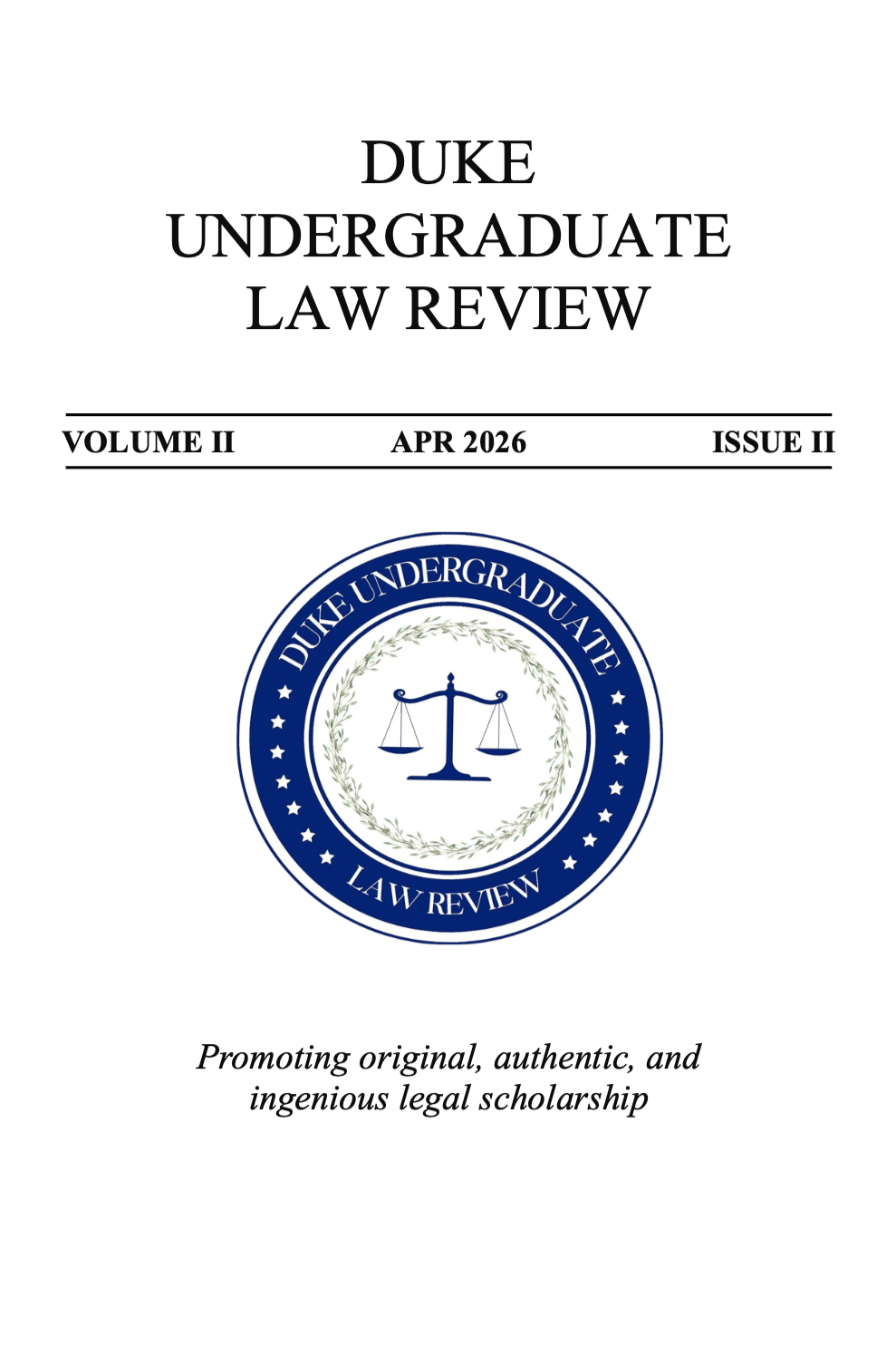
DUKE UNDERGRADUATE LAW REVIEW
The Duke Undergraduate Law Review (DULR) is Duke University’s premier undergraduate legal publication. DULR advances legal discourse by publishing print and online journals, covering an array of legal subjects. We seek to promote original, authentic, and ingenious legal scholarship.
Featured Roundtable Contributions
When a company misclassifies an imported product or certifies compliance with a dense trade regulation, the error has traditionally been treated as just an error. It might prompt an external audit, a civil penalty, or a course of correction, but rarely does it trigger allegations of fraud. Increasingly, that assumption no longer holds. Today, a mistake in filing can expose companies to damages, whistleblower suits, and years of litigation under the False Claims Act.
Justice Neil Gorsuch once wrote that judges should not be mistaken as “politicians in robes.” [1] The separation of powers between the judicial and legislative branch, while constitutionally apparent, is superseded as many label justices biased towards either conservative or progressive agendas. This particularly stems from the appointment process, wherein judges are selected by partisan Presidents who often base their decisions upon the preexisting alignments of their nominees. Such classifications carry a different meaning in the judiciary where law is not driven by politics; outcomes of court rulings are often unanticipated, solely grounded in constitutional right or wrong rather than ideological right or left.
The United States occupies a dichotomous role in the global order as both a primary security guarantor and the world’s largest arms exporter. This position creates a profound legal tension when American-manufactured munitions are linked to documented civilian harm in foreign conflicts. As reports of “gross violations of human rights,” or GVHR, surface in modern theaters of war, the legal community must grapple with the threshold for legal responsibility, both concerning the state and its individual actors, when providing the means for violations of International Humanitarian Law (IHL).
A cornerstone of the American legal system is the Sixth Amendment, which guarantees everyone the right to a fair jury trial. Despite this assurance, an increasing number of defendants are being sentenced without exercising their right to a full trial. Each year, around 98% of criminal cases in federal courts are being decided not by a trial, but by a plea bargain. Plea bargains are deals offered by the government before trial that grant defendants reduced sentences in exchange for an admission of guilt in court.
By Margalit Salkin
Developments in artificial intelligence are reshaping systems of technology and knowledge, sparking controversy about AI’s ethical implications. This paper analyzes how AI fits within the current understanding of U.S. copyright law. I propose the creation of a fair use text and data mining (TDM) exception for artificial intelligence, enabling the United States to respond to copyright ambiguities created by deep learning algorithms.
By Alex Precourt
The Department of Homeland Security (DHS) is moving forward with an expansive new plan to collect and store biometric data, including facial scans, fingerprints, and voice patterns, from all foreign travelers entering or leaving the United States. According to The Wall Street Journal, DHS plans to retain this data for up to seventy-five years, creating long-term biometric files for millions of travelers. Because biometric identifiers cannot be changed once compromised, privacy and cybersecurity experts have warned that large-scale biometric databases present especially attractive targets for hackers and foreign intelligence services. The Electronic Privacy Information Center (EPIC), for example, has cautioned that long-term retention of biometric data significantly increases the risk of misuse or catastrophic breach if systems are penetrated.
By Ameera Mehan
In the digital age, speech is more often penalized by online audiences than by the courts. The prevalence of social media has globalized public forums, voicing an overwhelming abundance of opinion and broadening the opportunity for civil discourse engagement. However, the risks posed by “cancellation” produce a coerced silence that is enforced, not by governmental power, but through fear of public condemnation.
By Jacqueline Rodriguez
In an era defined by rapid advances in artificial intelligence, the rise of leading chip manufacturers has reshaped both economic and regulatory landscapes. One such company that has established its dominance is NVIDIA. NVIDIA also holds an overwhelming market share in the AI and graphics processing unit (GPU) markets, capturing 92% in the add-in-board GPU market as of Q1 2025. Becoming the first company to reach $5 trillion in market value, its power and wealth are undeniable. However, NVIDIA’s rapid ascent from a graphics-card company to the world’s leading supplier of AI-accelerator chips has prompted new antitrust questions.
By Alix Sztejman
The Fifth Amendment’s protection against self-incrimination stands as one of the most profound constitutional barriers against government intrusion, protecting the sanctity of human thought from compelled discourse. This constitutional safeguard was established to prevent the state from forcing a defendant into a confession. However, what occurs when the government is able to access the mind directly, superseding speech entirely?